LMS
LMS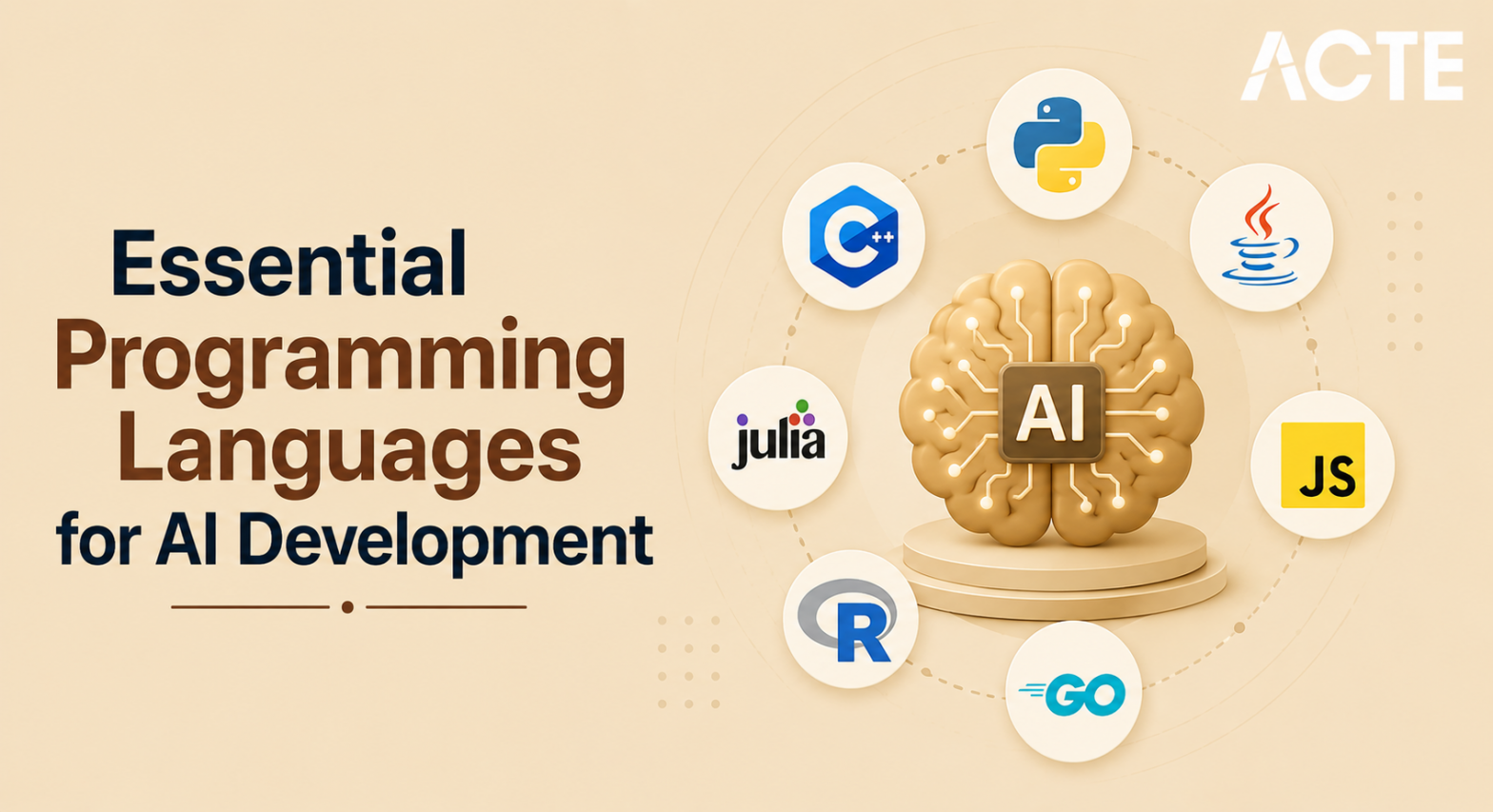
Last updated on 23rd May 2026| 13171

- Essential Programming Languages for AI Development
- Python: The Undisputed King of AI
- R: The Statistical Powerhouse
- C++: The Engine for High Performance
- JavaScript: Bringing AI to the Web Browser
- Java: The Enterprise Standard
- Julia: The High-Speed Math Specialist
- SQL: The Foundation of Data Access
- Conclusion
Essential Programming Languages for AI Development
Choosing the right programming language is one of the most critical early decisions you make when starting a career in artificial intelligence. Many freshers make the mistake of trying to learn every single language out of fear of missing out, which only leads to burnout and shallow knowledge. The truth is that AI development is not about memorizing syntax; it is about understanding how to manipulate data and implement mathematical algorithms in our AI Artificial Intaligence Training . Different languages serve completely different purposes in the AI ecosystem. Some are built for rapid prototyping, others are designed for heavy mathematical calculations, and others exist strictly to fetch data from massive databases. You do not need to be a master of all of them to get a job. You just need to master one primary language for building models and be familiar enough with the others to understand how they fit into a larger production system. By understanding the specific strengths and weaknesses of each language, you can focus your energy on the tools that actually align with your career goals. Staying proactive with language selection ensures stronger opportunities, and focusing on core mastery builds credibility. Over time, this strategy positions you as a fresher who can confidently begin AI development.
Python: The Undisputed King of AI
If there is only one language you learn for artificial intelligence, it absolutely must be Python. Python has completely monopolized the AI industry because it reads almost like plain English, allowing developers to focus on solving logical problems rather than fighting with complex syntax. The true power of Python lies in its massive ecosystem of libraries. Tools like TensorFlow, PyTorch, Scikit-Learn, and Pandas provide pre-built functions for everything from building deep neural networks to cleaning messy datasets. You do not have to code complex math algorithms from scratch; you simply import a library and call a function in our AI Artificial Intaligence Training. Every major AI framework, every tutorial, and almost all enterprise AI projects are built using Python. It is the universal language of machine learning. While it might not be the fastest language in terms of execution speed, its ability to rapidly prototype ideas makes it the ultimate starting point for any beginner. Mastering Python gives you access to ninety-nine percent of the AI job market and all the community support you could ever need. Staying consistent with Python practice ensures stronger preparation, and focusing on libraries builds credibility. Over time, this mastery positions you as a fresher who can confidently thrive in AI programming.
Ready to Get Certified in Artificial Intelligence ? Explore the Program Now Artificial Intelligence Online Training Offered By ACTE Right Now!
R: The Statistical Powerhouse
- Built by Statisticians for Statisticians: Unlike Python, which was built as a general-purpose programming language, R was created specifically for statistical computing and data analysis. If an AI project requires heavy statistical modeling, R is often the superior tool.
- Superior Data Visualization: R has incredible visualization libraries like ggplot2 that allow you to create highly complex, publication-ready charts and graphs with very few lines of code. for more Top 10 Real Life Application Of AI You Use Every Day, It is the favorite tool for data scientists who need to present their findings to non-technical executives.
- Dominance in Academia and Research: If you read academic papers on artificial intelligence or biostatistics, the vast majority of the code and datasets provided will be in R. It is heavily used in pharmaceutical research and healthcare AI.
- Rich Ecosystem of Specialized Packages: The Comprehensive R Archive Network (CRAN) has thousands of packages dedicated to niche statistical tests, time-series forecasting, and econometric modeling that simply do not exist in Python.
- When to Choose R Over Python: You should learn R if your specific AI career goal is focused on heavy data analysis, financial forecasting, or bioinformatics rather than building software applications. It is a specialist tool for highly analytical minds.

Develop Your Skills with Artificial Intelligence Training
Weekday / Weekend BatchesSee Batch DetailsC++: The Engine for High Performance
While Python is the language you use to design the AI model, C++ is often the language running behind the scenes to make that model actually work fast. Python is an interpreted language, which makes it relatively slow when processing massive amounts of data in real time. C++ is a low-level language that allows you to manage memory directly, making it incredibly fast. When you use PyTorch or TensorFlow in Python, the heavy mathematical calculations are actually being executed by C++ code running under the hood. As an AI engineer, you rarely write entire AI Applications in C++ from scratch. However, if you are working on self-driving cars, robotics, or high-frequency trading algorithms where the system must process millions of data points in milliseconds, you must know C++.
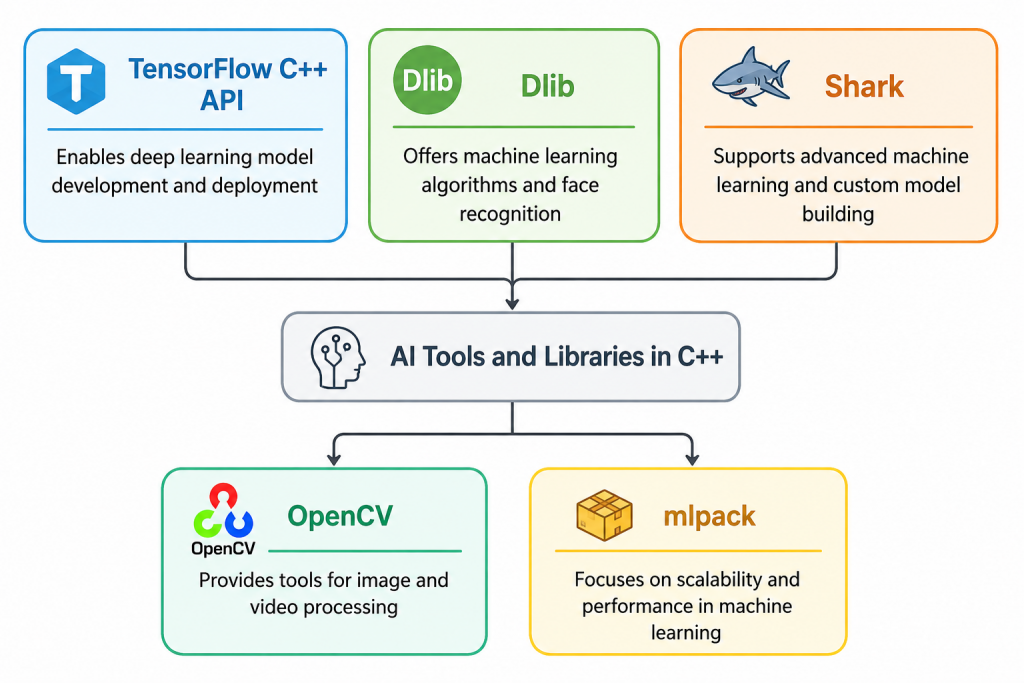
It is the language used to deploy AI models in resource-constrained environments like edge devices and autonomous drones where speed is more important than easy readability. Staying consistent with C++ practice ensures stronger preparation, and focusing on performance builds credibility and see AI Movie List. Over time, this mastery positions you as a fresher who can confidently handle high-performance AI systems.
JavaScript: Bringing AI to the Web Browser
Artificial intelligence is traditionally run on massive cloud servers because models require heavy computational power. However, the demand for running lightweight AI directly inside a user’s web browser is exploding. This is where JavaScript becomes essential for AI development. Libraries like TensorFlow.js allow developers to take pre-trained machine learning models and run them entirely on the client side using the browser’s processing power. This is incredibly useful for building real-time features like face detection on a website, voice-to-text translation, or interactive recommendation engines without sending the user’s private data back to a server and Emerging AI Trends in the IT Industry . As a fresher, learning how to integrate AI into web applications using JavaScript makes you a highly valuable full-stack AI developer. You might not use JavaScript to train the model, but you will absolutely use it to deliver the model to the end user in a fast, interactive, and secure way. Staying proactive with JavaScript practice ensures stronger opportunities, and focusing on web integration builds credibility. Over time, this mastery positions you as a fresher who can confidently deliver AI in browser-based environments.
To ExploreArtificial Intelligence in Depth, Check Out Our Comprehensive Artificial Intelligence Online Training To Gain Insights From Our Experts!
Java: The Enterprise Standard
Even though Python gets all the media attention, Java is still the backbone of massive enterprise software systems. Large banks, insurance companies, and telecom networks have spent decades building their IT infrastructure using Java. When these corporations decide to integrate artificial intelligence into their existing systems, they cannot just rip everything out and rewrite it in Python. They need AI engineers who know how to build machine learning models using Java-based libraries like Deeplearning or Weka, or who know how to use Java to build the microservices that connect Python models to their legacy databases and Easy AI Projects For Freshers. Java is also famous for its strict type safety and excellent performance on multi-threaded processing, making it great for building large-scale data pipelines. If your goal is to work as an AI engineer in a massive corporate environment rather than a trendy tech startup, having Java on your resume alongside Python makes you incredibly resilient to layoffs and highly attractive to conservative financial institutions. Staying consistent with Java practice ensures stronger preparation, and focusing on enterprise integration builds credibility. Over time, this mastery positions you as a fresher who can confidently thrive in corporate AI environments.
Looking to Master Machine Learning? Discover the Artificial Intelligence Expert Masters Program Training Course Available at ACTE Now!
Julia: The High-Speed Math Specialist
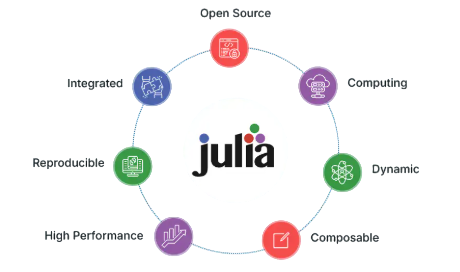
- Built for Speed and Simplicity: Julia was created to solve the challenge of balancing development speed and execution performance. It offers a simple and readable syntax similar to Python while delivering high-speed execution. This makes Julia attractive for developers working on computationally intensive applications.
- Solving the Two-Language Problem: Traditionally, developers write applications in high-level languages and rewrite performance-critical sections in lower-level languages for speed thats Why AI Is a Promising Career Option for IT Freshers. Julia reduces this need by combining ease of coding with strong execution performance, allowing developers to build and optimize within one language.
- High Performance for Mathematical Computing: Julia is designed for advanced mathematical and scientific workloads. Features such as multiple dispatch help improve efficiency in numerical computation, linear algebra, and large-scale data processing. This architecture makes Julia suitable for research and complex computational environments.
- Applications in Advanced Technology Fields: Julia is gaining attention in specialized domains including artificial intelligence, quantum computing, financial analysis, and physics simulations. Although its ecosystem is smaller than Python, its performance advantages make it increasingly useful in modern research and engineering projects.
- Learning Path and Future Potential: For beginners, Julia should be viewed as a later-stage skill rather than a Python replacement, and Explore more in A Step-by-Step Guide to Becoming an AI Engineer . Once projects involve massive datasets and computational bottlenecks, Julia becomes valuable. As AI and scientific workloads continue growing, Julia adoption is expected to expand further.
Preparing for Artificial Intelligence Job Interviews? Have a Look at Our Blog on Artificial Intelligence Interview Questions and Answers To Ace Your Interview!
SQL: The Foundation of Data Access
No matter how brilliant your artificial intelligence model is, it is completely useless without data, and almost all enterprise data lives inside relational databases. SQL, or Structured Query Language, is not a language for building AI algorithms, but it is the most critical language for fetching the data that feeds those algorithms in AI Artificial Intaligence Training. As an AI professional, you will spend a massive portion of your time writing SQL queries to join tables, filter out bad data, aggregate metrics, and extract exactly what you need before you ever write a single line of Python. Many beginners focus so heavily on learning neural networks that they completely ignore database fundamentals. This is a massive mistake. If you cannot write a complex SQL query to pull a clean dataset from a company’s data warehouse, you cannot train your model. Mastering SQL ensures you can independently access the raw materials of AI, making you a highly self-sufficient and effective engineer on any data science team. Staying consistent with SQL practice ensures stronger preparation, and focusing on data access builds credibility. Over time, this mastery positions you as a fresher who can confidently thrive in AI development.
Conclusion
Building a successful career in AI development does not require you to learn every programming language in existence. It requires you to strategically master the tools that fit your specific role. Python is the mandatory starting point that opens all the doors in the industry. From there, your career path dictates your next steps. If you want to build web applications, add JavaScript. If you want to work in high-frequency finance, learn Java and C++. If you want to focus purely on deep statistical research, learn R and AI Artificial Intaligence Training. Above all else, never neglect SQL, because data access is the foundation of everything you will ever build. Stop jumping between tutorials for different languages and focus your energy on deeply understanding the syntax, libraries, and data structures of your primary stack. Once you have a solid foundation in one language, picking up a second or third becomes incredibly easy. Master your core tool, understand how it interacts with the rest of the system, and start building real projects to prove your skills. Staying disciplined with language mastery ensures stronger opportunities, and focusing on project building builds credibility. Over time, this strategy positions you as a fresher who can confidently grow in AI programming.